Blog Details

Forex Risk Management: Essential Guide to Protecting Your CapitalRisk Management

Forex Risk Management: Essential Guide to Protecting Your Capital

Master position sizing, stop-loss strategies, and risk-reward ratios. Learn why risk management is more important than your trading strategy.

Lisa Martinez - Author
Written ByLisa MartinezCFD & Derivatives Analyst
James Wilson - Fact Checker
Fact Checked ByJames WilsonRisk Management Specialist
Last UpdatedDec 14, 2026


Frequently Asked Questions

The 1% rule states that you should never risk more than 1% of your total account balance on a single trade. If you have $10,000, your maximum loss on any trade should be $100.
It is strongly discouraged. Volatility spikes, internet disconnections, or broker outages can leave you exposed to unlimited losses. Some traders use mental stops, but these are vulnerable to emotional overrides.
Hedging involves opening a position to offset the risk of another. For example, opening a Sell on EUR/USD to protect a Buy position during volatile news. It's a risk management technique, not a profit strategy.
Use the formula: Position Size = (Account Balance × Risk %) ÷ (Stop-Loss Pips × Pip Value). For example, $10,000 × 1% ÷ (50 pips × $10) = 0.2 lots on EUR/USD.
Most professional traders aim for at least 1:2 (risk $1 to make $2). This allows for profitability even with a win rate below 50%. Higher ratios like 1:3 are even better but may result in fewer trades.
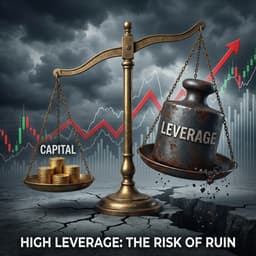
Effective leverage of 1:5 to 1:10 is considered moderate and appropriate for most traders. Using more than 1:20 effective leverage is generally too aggressive and increases the risk of account blowups.
Lisa Martinez

Lisa Martinez

CFDs • Options • Derivatives

About the Author

Lisa began her career on the trading floor in London dealing in options and futures. With expertise in complex derivative products, she evaluates CFD brokers and educates traders on hedging strategies and product offerings.

CFD & Derivatives Analyst — Everything you find on BrokerAnalysis is based on reliable data and unbiased information. We combine our 10+ years finance experience with readers feedback.

All Comments (0)

Sort By:

No comments yet. Be the first to share your thoughts!

Write a Comment

Search

Share With